
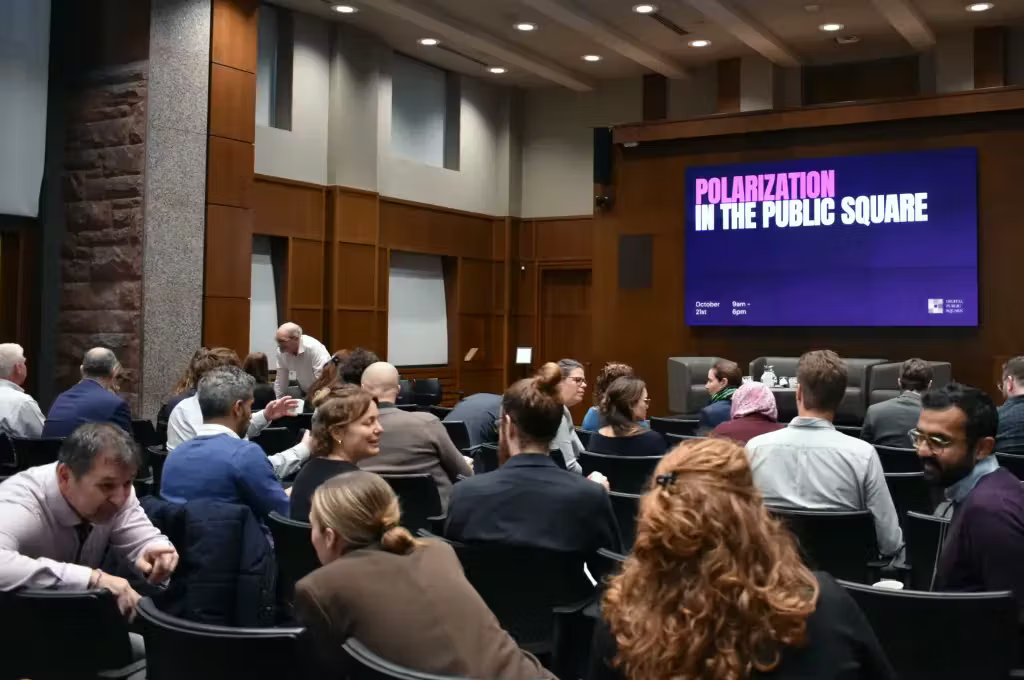
In October 2025, Digital Public Square held the Polarization in the Public Square Conference, an opportunity for civil society, academia, and government to come together to explore solutions to the growing problem of political and social polarization in Canada.
Polarization poses an urgent threat to the health of our democracy and the social fabric of our communities. Canadians are becoming more divided in how we perceive our social and political identities, leading to a rise in extreme ideologies and growing distrust in our democracy.
Disagreement, of course, is a fundamental feature of our political system. It’s how positions are formed, voters make decisions, and policies get made. There are also many good reasons for people to hold positions that don’t fall in the middle.
Increasingly, however, we are seeing those we disagree with not just as people with different views—or even political rivals—but as enemies who pose a threat to our way of life. This environment can breed illiberal political movements, political and ideological violence, and social isolation.
When trust breaks down—trust in our institutions, in our media, and in one another—our collective ability to solve complex, real-world problems falters. Polarization inhibits effective governance, stalls critical action, and makes it impossible to address pressing economic and social inequalities with unity and expertise. It damages the very communities we aim to serve by replacing constructive dialogue with antagonism, intolerance, and, in some cases, avoidance.
This phenomenon is accelerated and amplified by our digital environment. Algorithmic echo chambers, mis- and disinformation, and social media outrage cycles have created segmented realities. As Canadians, we are increasingly occupying different informational worlds, and this divide has tangible, negative consequences.
Digital Public Square recently ran a survey to measure the state of polarization in Canada. The results were eye opening. We found that affective polarization—the dislike of those with opposing views—is high.
Our survey found that the more left or right one identifies, the more negatively they see the other side, and the more positively they see themselves. They see the other side as immoral, intolerant, and extreme, and see the opposite traits in themselves. This is a well-researched phenomenon that has occurred in various contexts and, unfortunately, Canadians are following this path.
It’s not hard to see how polarization can corrode our democracy over time. Recognizing this problem, we organized the Polarization in the Public Square Conference to bring together researchers, practitioners, and government representatives to develop solutions to polarization before it’s too late.
We wanted to bring attention to the issue of polarization and explore how it intersects with societal challenges such as extremism, illiberalism, and intolerance. Our speakers came from a diverse range of personal and professional backgrounds. What they had in common was a commitment to standing up to polarization in our society—whether in our universities, places of worship, or online spaces.
The challenge is daunting and the solutions aren’t obvious. But by foregrounding community experiences and exploring innovative approaches to foster empathy and dialogue, we can begin to rebuild common ground.
Here’s what we learned at the Polarization in the Public Square Conference.
Keynote address - Mohammed Hashim, CEO of the Canadian Race Relations Foundation
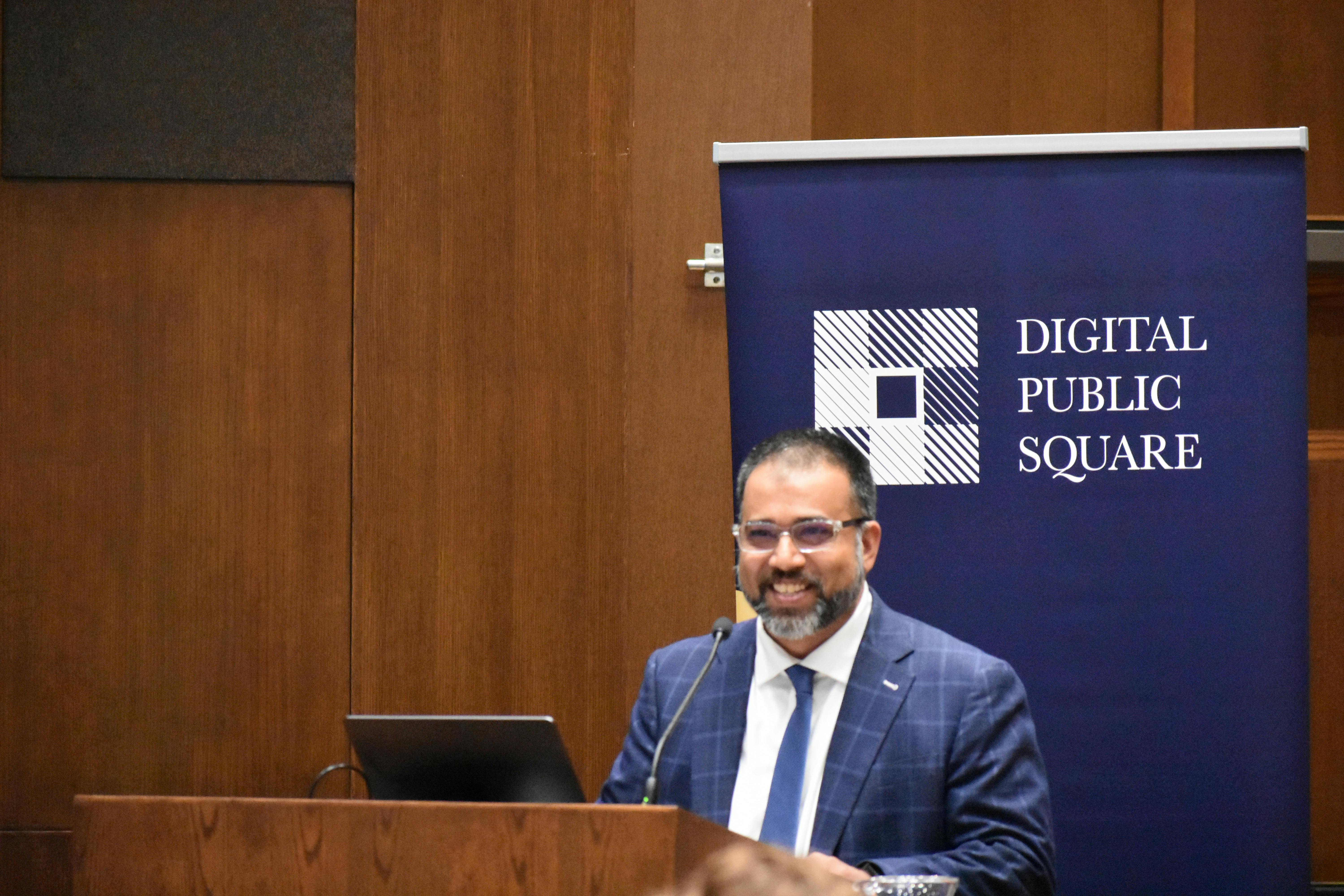
Mohammed Hashim explored what a polarizing Canada means for us all. Mohammed observed that our online environment is driving polarization, leading to an increase in hate and undemocratic politics. Hate crimes are not random, isolated incidents: they are fuelled by an unpredictable and unregulated online environment.
To respond to this polarization, Mohammed said our policies need to lead from a place of possibility instead of fear. We need to rebuild human connections and make communities a part of healing our society.
Mohammed’s words are a reminder that polarization is not inevitable. Canadians can make the choice to work together to foster meaningful relationships and stand up to the forces driving polarization.
Panel 1 - Living and working in polarized communities
- Randy Boyegoda, University of Toronto Provostial Advisor on Civil Discourse and Professor of English
- Urz Heer, Interfaith Council of Peel and City of Brampton civic engagement
- Ben Rowswell, Circle for Democratic Solidarity and former Canadian Ambassador to Venezuela
- Moderated by Ghayda Hassan - founder and Director of the The Canadian Practitioners Network for the Prevention of Extremist Violence (CPN-PREV)
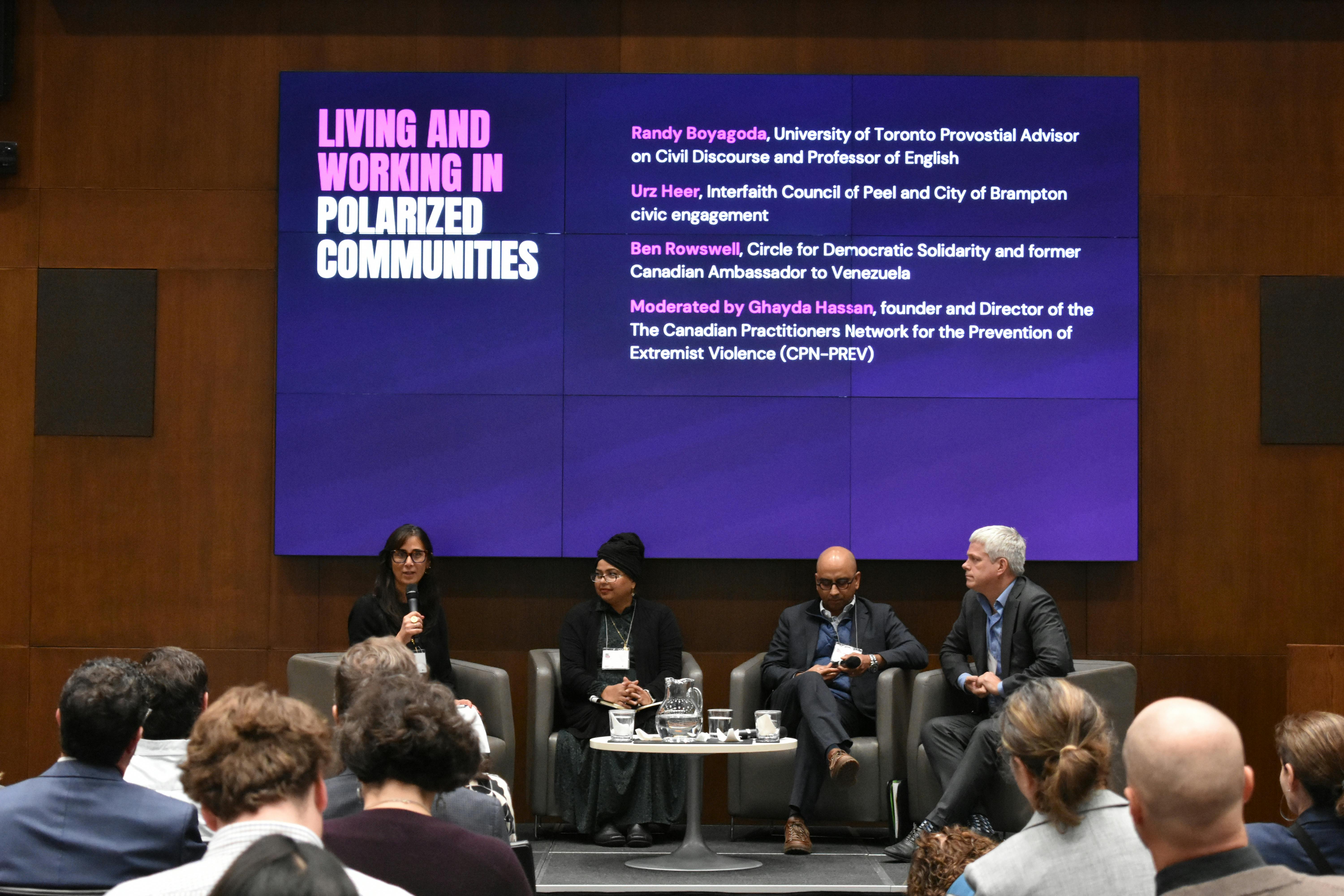
This panel was made up of people from organizations that are delivering services in contentious times. These individuals and organizations must navigate polarized viewpoints among service recipients, employees, and the public. From the hospital to the university campus, from City Hall to the school district, senior professionals have to deliver appropriate services while contending with polarized demands, opinions, beliefs, and news sources. How are they navigating these challenges and can they identify successful approaches?
Randy Boyegoda discussed efforts to restore trust in universities around Israel-Gaza; Ben Rowswell shared his experiences in holding conversations about residential schools and their horrific impacts Indigenous peoples; and Urz Heer spoke of challenges and opportunities in promoting interfaith trust and dialogue in Brampton. Though each panelist was confronted with a unique set of challenging circumstances, they shared a belief in the importance of civil discourse and finding space for participation and expression to foster functioning societies. The panelists emphasized that regardless of the issue at hand, we need to create opportunities to have honest dialogue and think through problems together.
Panel 2 - Unpacking polarization in Canada
- Anne E. Wilson, Professor of Social Psychology at Wilfred Laurier University
- Michael Wohl, Professor of Psychology at Carleton University
- Moderated by Ben Windeler, Digital Strategy Lead at Digital Public Square
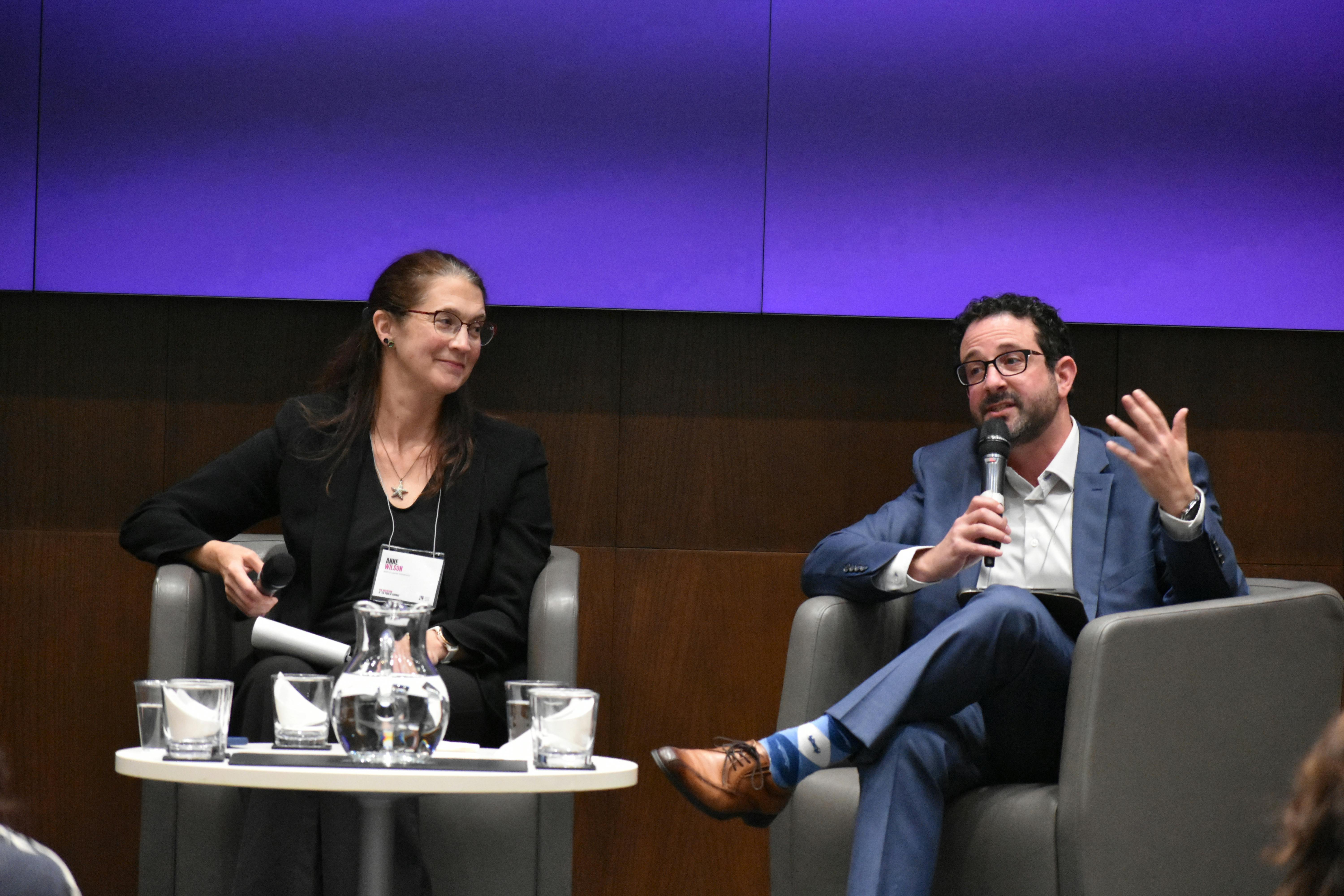
This panel saw Canadian psychology and social science professors discuss what we know about polarization in Canada and what we don’t yet know. The panelists explored how far the academic community has come in understanding the drivers and impacts of polarization in Canada, and offered thoughts and recommendations on where the field should focus future research.
Dr. Wilson and Dr. Wohl highlighted the importance of social identity and group belonging as psychological drivers of polarization. When we view our social group as under threat, we risk developing a combative “us versus them” mentality.
To combat rising polarization, the panel discussed the need to address misperceptions that groups have about one another, emphasize shared values and identities that groups hold in common, and empower in-group dissenters who are unafraid to speak up, work with people from other groups, and establish positive behaviours.
Dialogue session - Conflict resolution, capacity-building and dialogue between polarized communities in a fracturing public square
- Niki Landau, founder and CEO of C-Space, providing creative solutions to conflict
- Bashar Al-Shawwa, Director of Strategic Communications and Advocacy at C-Space
- Moderated by Jeff Wilkinson - Co-author of “The Wall Between - What Jews and Palestinians Don't Want to Know about Each Other”
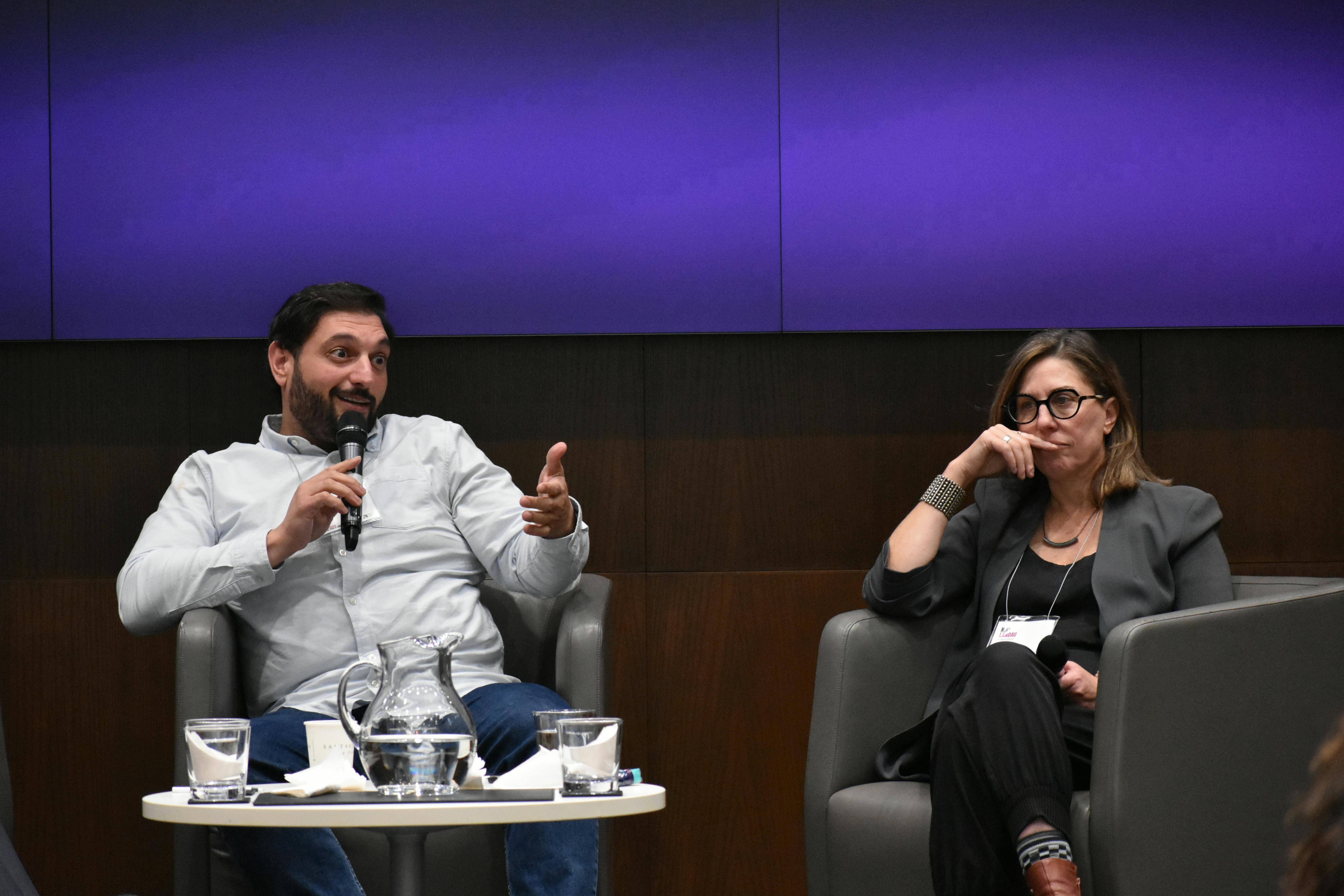
We heard from Niki Landau and Bashar Alshawwa from C-Space Group about their experience teaching and leading conflict resolution, capacity-building and dialogue sessions in Canadian institutions, organisations, and communities, what has changed in recent times, and how they are adapting to the challenge.
Moderated by Jeff Wilkinson, co-author of The Wall Between - What Jews and Palestinians Don't Want to Know about Each Other, the panel spoke to the difficult but transformative potential of inter- and intra-group dialogue sessions to overcome conflict and polarization.
Niki and Bashar told the audience that when we listen and ask questions about the feelings behind people’s positions and disagreements, we can build understanding between one another. By listening to each other and having brave conversations, we can discover that we often have more in common than we think.
Panel 3 - The information challenge: media, new media, and the challenge of informing the public square
- Michele Austin, former VP Public Affairs at Bell and former Director of Public Policy at Twitter (US & Canada)
- Justin Ling, investigative journalist and publisher of the substack “Bug-eyed and Shameless - Dispatches from the fringes of the information war”
- Sandra E. Martin, Standards Editor for the Globe & Mail
- Moderated by Bill Killorn - Co-Executive Director of Journalists for Human Rights
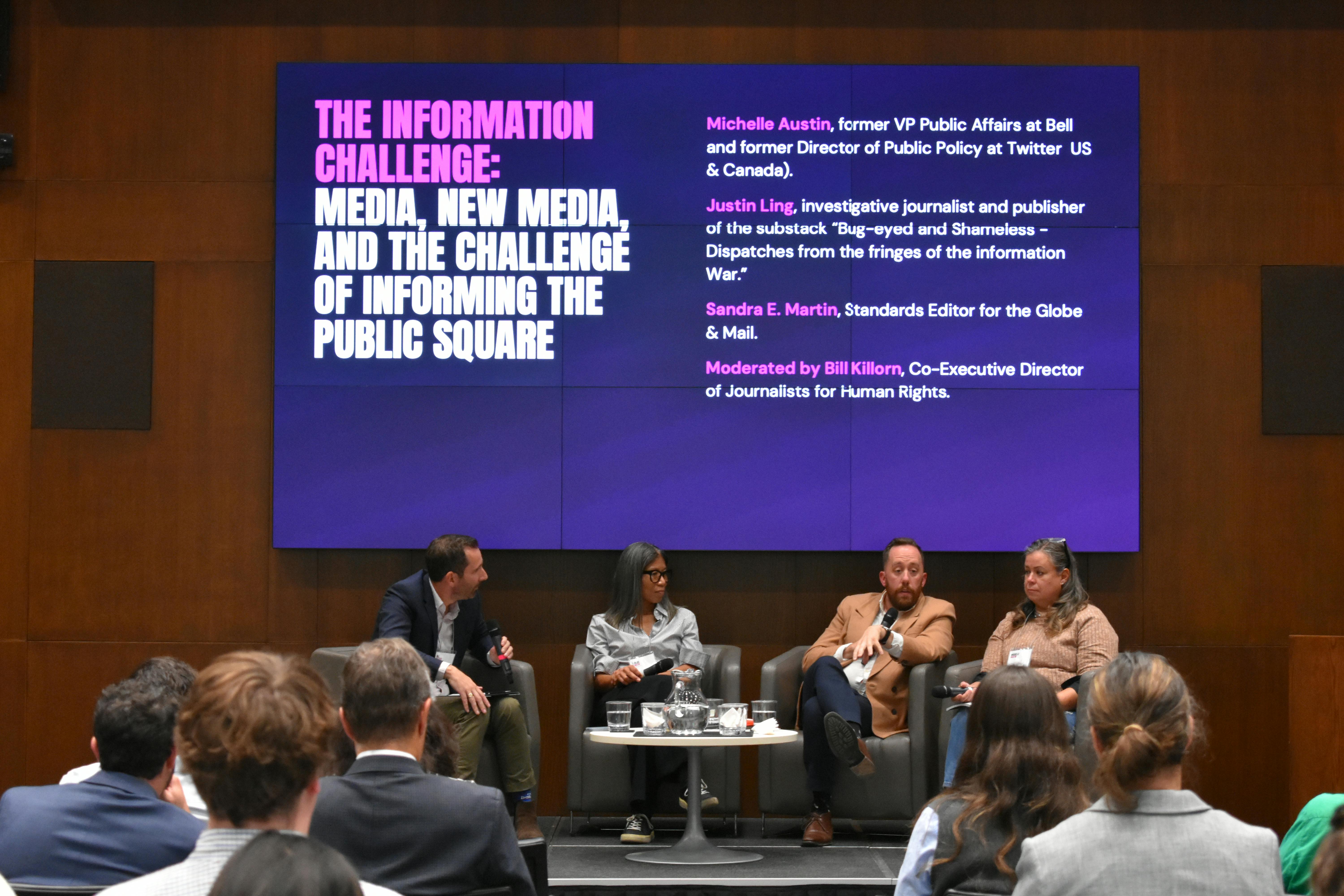
Panelists from both long-established and new media outlets discussed how the process of informing the public square is changing, how they are adapting to that change, and how their own approaches can help protect the space for dialogue over the long term. Panelists discussed the challenges of reporting in a polarized political environment, how changes in news consumption affect polarization, and what media can do to rebuild public trust.
The panel highlighted the challenges of strengthening Canadian media in an information environment influenced by powerful social media companies and opaque algorithms. To survive in an increasingly fragmented information landscape, there is a need for the media to avoid contributing to the problem and find innovative ways to build trust with the public.
Panel 4 - The power of community: Canadian civil society responses to polarization
- Isabeau Morin - Digital Public Square Project Lead on polarization and vulnerability to online extremism
- John Beebe, founder of the Democratic Engagement Exchange at Toronto Metropolitan University and advisor to the Dean of the Faculty of Arts
- Yusuf Siraj, Co-founder of Foundation for a Path Forward
- Moderated by Yafa Sakkejha - Yafa is the CEO of Beneplan and an advocate for peace and depolarization
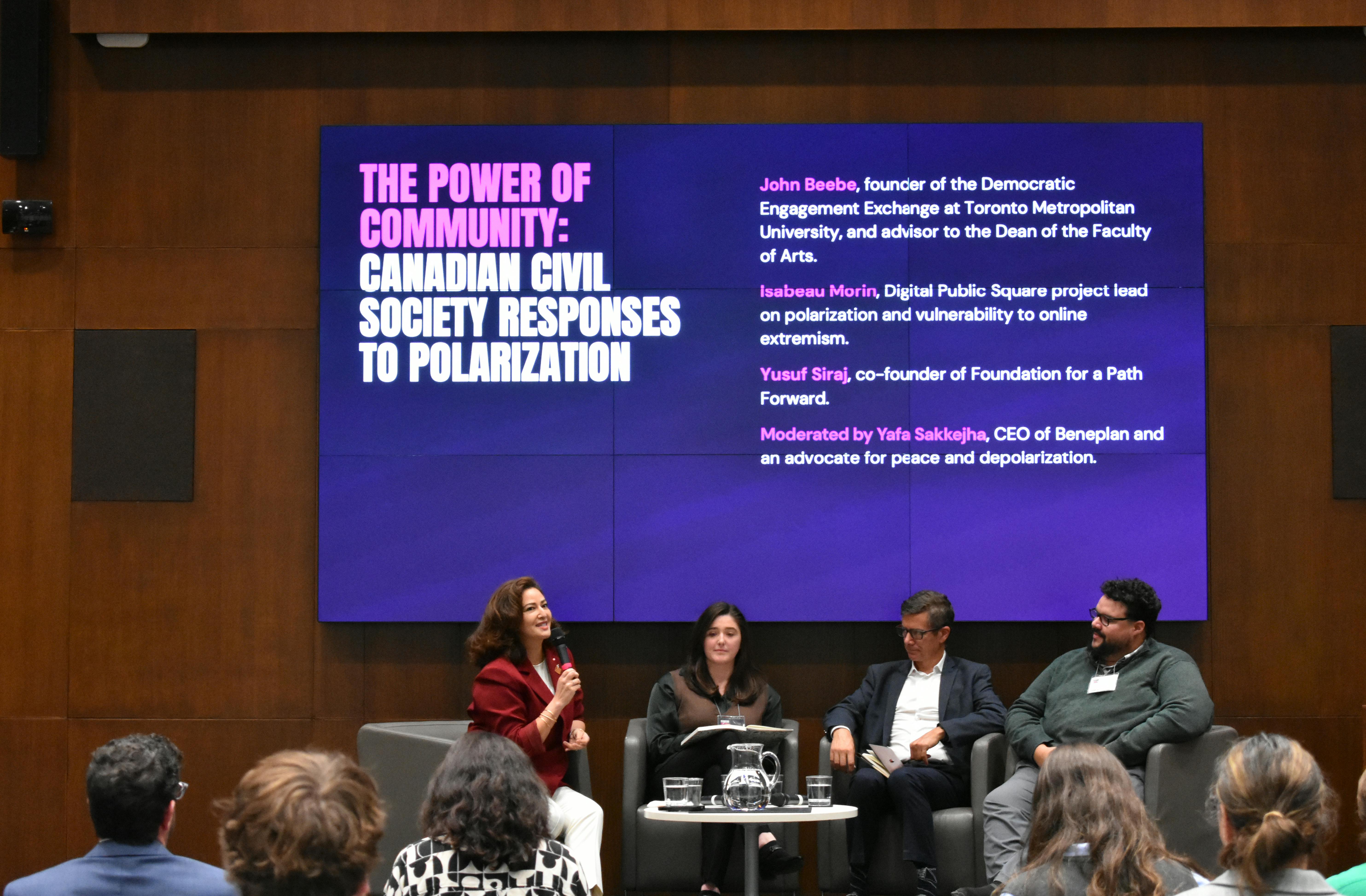
A panel of Canadian civil society organizations discussed innovative ways they have faced the challenge of addressing polarization within and between communities while preserving dignity, democratic action and space for dialogue. This panel explored where technology can be a positive tool for improving these outcomes and where more work is needed.
The panel spoke of the importance of engaging people who often don’t participate in politics in creative ways. When we create opportunities for communities to listen to each other and talk about issues beyond what we disagree about most, we find that we often have more in common than we think.
Fireside chat - Creating meaningful dialogue on Israel-Palestine: Shlomit Broder presents a conversation with Raja Khouri and Mira Sucharov
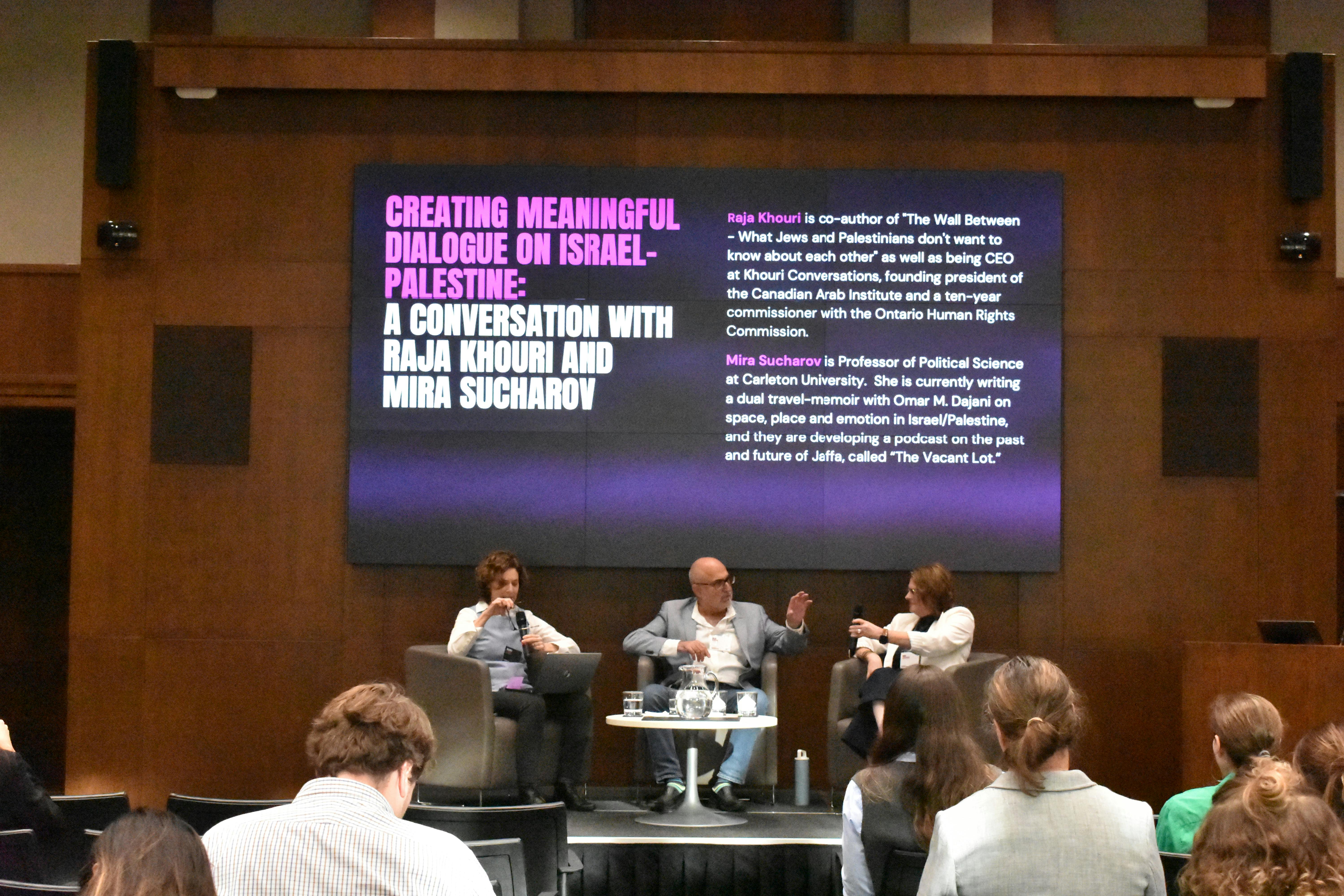
Raja Khouri is co-author of "The Wall Between - What Jews and Palestinians don't want to know about each other" as well as being CEO at Khouri Conversations, founding president of the Canadian Arab Institute and a ten-year commissioner with the Ontario Human Rights Commission.
Mira Sucharov is Professor of Political Science at Carleton University. She is currently writing a dual travel-memoir with Omar M. Dajani on space, place and emotion in Israel/Palestine, and they are developing a podcast on the past and future of Jaffa, called “The Vacant Lot.”
Raja Khouri launched Khouri Conversations to deepen intercultural understanding and explore ways towards meaningful dialogue on Arab and Jewish relations in the diaspora. Mira Sucharov, a professor at Carleton University, has developed a close writing partnership on Israeli-Palestinian relations with Omar M. Dajani at the University of the Pacific. Mira has spoken regularly about the difficulties researching, collaborating, writing, and talking about Israel and Palestine since October 7, 2023. Raja and Mira shared their experiences and approaches together and Shlomit Broder from Digital Public Square invited questions from the floor.
Raja and Mira spoke to the importance of exposing Jewish and Palestinian communities to each other’s experiences and narratives. Without understanding where others come from, we make assumptions about how they feel and why they hold their views. By listening to others, we can build bridges, enrich our own understanding of ourselves, and create the foundation for political and social change.
Finding ways to bridge Canada’s divides
At the Polarization in the Public Square Conference, we heard how polarization prevents social and political progress in a range of contexts and on numerous issues. From stalling truth and reconciliation about Canada’s history with Indigenous peoples, to further fracturing the country’s media and information landscape, to dividing communities based on their views on Israel-Gaza, polarization impacts the most urgent issues Canada is facing.
While polarization can create vicious cycles that degrade our social and political fabric, we also heard about innovative strategies to counteract these forces. Although speakers at the Polarization in the Public Square Conference came from a variety of different backgrounds, common themes on tackling polarization emerged.
One of these key themes was the importance of listening. If we create space for genuine listening, we can test our assumptions about other people and learn where they are coming from. Those who share their perspectives can move beyond reflexive debates, gain greater reflection on why they hold the views they hold, and learn about others’ perspectives and narratives. Over time, conversations like these can break down barriers between those with seemingly opposing views.
Another key theme was the importance of finding values and identities that cut across groups and bridge differences. Often, groups think they are more different from one another than they really are in reality. When we put what we hold in common at the forefront—whether it’s being neighbours in a local community or sharing fandom in a sports team or supporting a bigger principle—these values and identities can transcend other differences or disagreements.
Finally, another theme was the role of structural factors in driving polarization. Unaccountable social media companies ignite polarization as part of their business models. Economic precarity and unresponsive governance erode trust in our institutions and create demand for polarizing movements and narratives. There is a proliferation of organized movements seeking to radicalize people online.
These structural challenges are the biggest roadblocks to addressing polarization. In controlled settings, facilitated listening and dialogue sessions can break down walls and depolarize participants. Institutions like civil society organizations, universities, and workplaces can emphasize shared identities to bring communities together. However, to confront polarization at the societal level, these efforts need to be scaled up to reach Canadians across the country, while governments need to bake in responses to polarization in their policies and legislation.
These barriers make standing up to polarization a formidable challenge. But we know a lot about what works—and what doesn’t work—in depolarizing our communities. The next step is to invest in solutions and do the work to bring Canadians across the country together.
In close collaboration with partners, Digital Public Square is testing approaches—both online and offline—for reducing polarization in Canada. Findings and learnings from these experiments will be available in Spring 2026. Follow Digital Public Square to stay up to date with our work on countering polarization in Canada.