
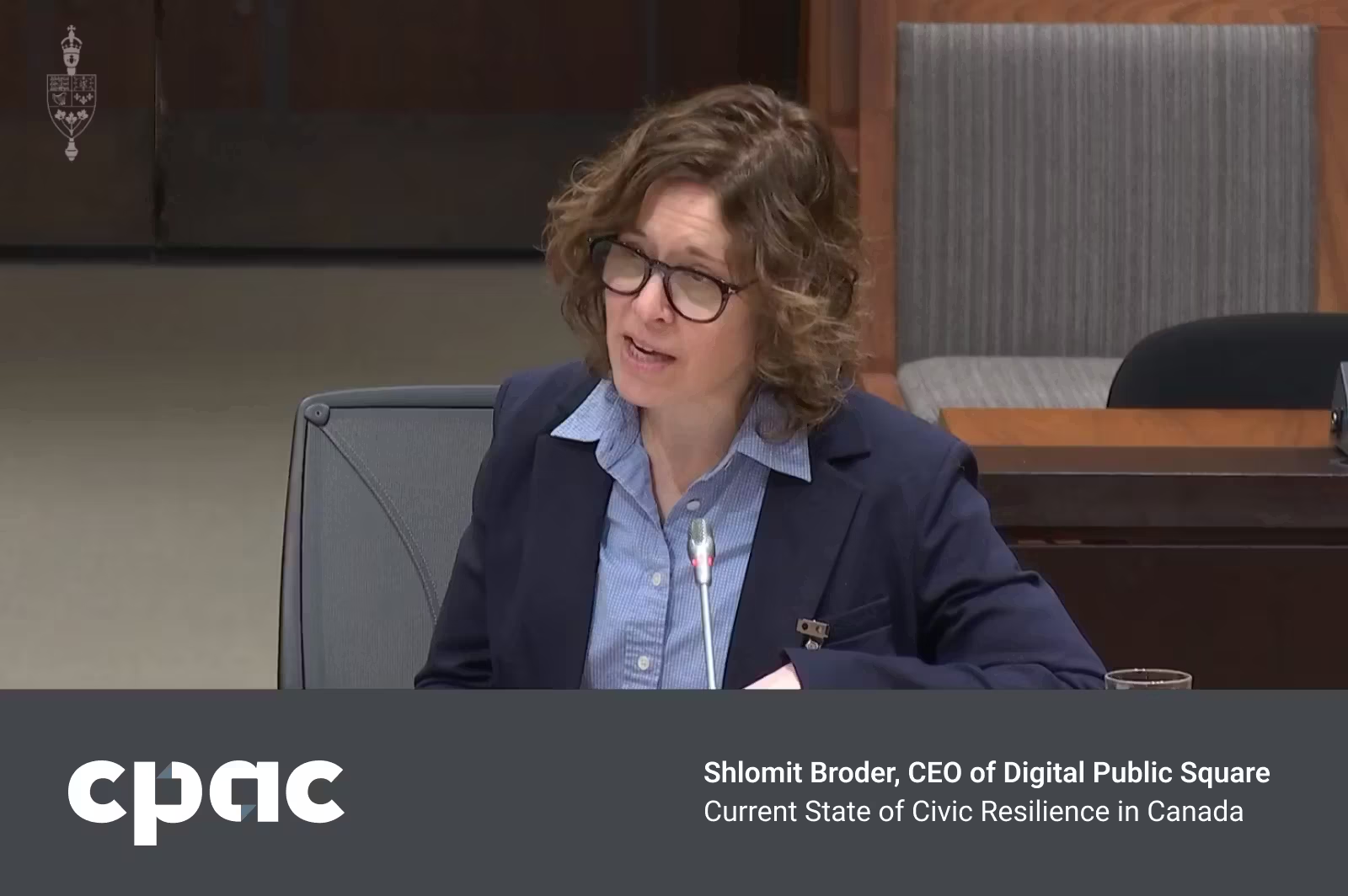
On April 21, 2026, Digital Public Square’s CEO, Shlomit Broder, testified to the Standing Committee on Procedures and House Affairs on the current state of civic resilience in Canada.
Watch Shlomit's testimony here: https://www.youtube.com/watch?v=MuzBwe3BANk
The following is a transcript of Shlomit’s testimony.
My name is Shlomit Broder and I am the CEO of Digital Public Square, a Canadian not-for-profit. Throughout the last decade, we have worked to bolster civic resilience in Canada and abroad by creating digital spaces that allow for greater participation, encourage critical thinking and invite more voices to be shared and heard in a productive and respectful manner.
Today, I will speak to two areas: the state of polarization in Canada, and the role digital spaces can play in strengthening civic resilience.
Across the world, we are seeing deepening polarization, growing information manipulation threats, and declining trust in institutions. Canada is not immune to these challenges and I believe it is a critical moment to take a thoughtful and proactive approach to safeguarding and strengthening our civic resilience.
Our nationally representative surveys show that Canadians perceive the country to be far more polarized than it actually is. Many believe that those with opposing political views are more extreme than they truly are, and underestimate how much common ground exists in our shared priorities.
In our July 2025 survey, 30% of Canadians said the country is highly polarized, and 62% stated that they are concerned the political left and political right can’t speak to each other about political and social issues. Yet when we look at how Canadians actually identify politically, the picture is quite different. Most Canadians are ideologically centrist. Within our survey, 66% of Canadians placed themselves in the three middle pillars on a 7-point scale between political left and political right, and only a small minority identified at the ideological extremes.
This gap between perception and reality matters. Canadians who perceive high levels of polarization tend to have lower trust in institutions, are less satisfied with democracy, and are more likely to feel the country is heading in the wrong direction. Our research also shows that as individuals identify more strongly with the political left or right, they tend to view their own group increasingly positively and the opposing group increasingly negatively. At the extremes, they question the other side’s morality.
Disagreement itself is not the problem, nor are strong political viewpoints. We invite differences of opinion in this country. The risk arises when difference turns into division and people begin to see those on the other side of an issue not simply as wrong, but as illegitimate or even dangerous.
What is driving polarization?
Politicians and political parties were the most cited cause of polarization by all Canadians. Those on the right were more likely than other Canadians to point to the political system and the country’s diverse makeup as additional causes of polarization. Those on the left were more likely than other Canadians to cite social media platforms and online influencers as causes.
Polarization is not a new phenomenon, yet Canadians perceive it and experience it to be increasing. Within this context we must acknowledge the role of social media platforms that are designed to amplify the most extreme and emotionally charged content. They often expose users to the worst representations of opposing views, distorting our perception of the public square and reinforcing an “us versus them” dynamic.
What do I propose we do?
I propose that we make Canada’s civic resilience a national priority, strengthening civic engagement, rebuilding trust, and fostering greater social cohesion. Achieving this requires a deliberate, non-partisan framework that brings together government, civil society, researchers, and the private sector. Important efforts are already underway across the country and have been for years. The opportunity now is to better align them and invest in sustained, long-term initiatives so that, collectively, they deliver a more meaningful and measurable impact for Canadians.
With respect to digital spaces, where much of my work is focused, we should not limit ourselves to reducing online harms. We should also seize the opportunity to actively use these spaces to engage Canadians and strengthen civic resilience. Our work has shown that when people are encouraged to engage thoughtfully with complex and often contentious issues in a respectful, judgment-free digital environment, they become more resilient to polarizing narratives. When individuals feel that their concerns are heard and taken seriously, they are more open to nuanced information and more willing to engage across differences.
Importantly, these kinds of digital initiatives allow us to reach Canadians who may not participate in more traditional forms of civic engagement, broadening both access and impact.