

Over the past year, Digital Public Square has been bringing Canadians together to hold dialogues on Israel-Palestine and challenge assumptions about Palestinian and Jewish Canadians. In collaboration with C-Space Group and Khouri Conversations, we convened a series of in-person dialogue sessions where Palestinian and Jewish Canadians came together to discuss how they have been affected by the post-October 7 environment, share their lived experiences, and hear from voices they are not normally exposed to.
The impacts of these dialogues were significant. Across sessions, participants moved from mistrust towards cautious reciprocity, responding to the emotions they heard rather than the motives they feared. Over time, a sense of camaraderie began to form despite enduring disagreements — demonstrating what it can look like for Palestinians and Jews to meet in Canada, remain present with one another, and work toward understanding.
Dialogue sessions can be transformative, but are difficult to scale. They require experienced mediators and small groups of dedicated participants willing to meet multiple times over several months. Moreover, not everyone is comfortable participating in these types of activities. Following the success of our dialogue series, we asked ourselves: how can we scale the impacts of dialogue to reach more Canadians across the country?
Voices – bringing the dialogue experience online
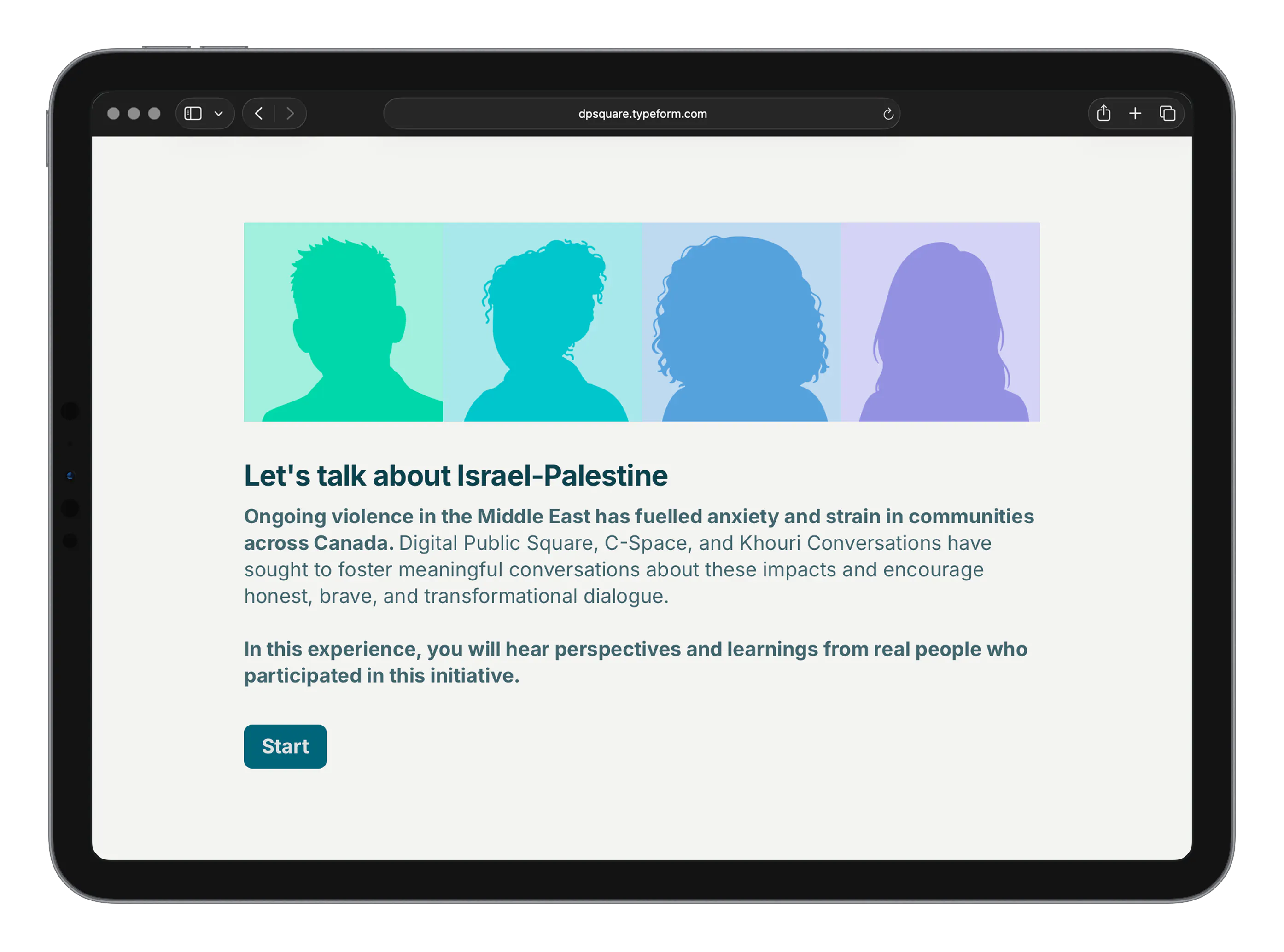
In response to this challenge, we developed Voices, a prototype designed to translate the experience of dialogue sessions into a short online interaction. We wanted to test a model for delivering the experience of dialogue in a brief, private, self-guided online experience.
Voices features four “profiles” of Canadians with different backgrounds and views on Israel-Palestine, each based on real participants from our in-person dialogue sessions. Users can engage with these profiles by selecting the one they are most interested in exploring, selecting question prompts, and responding to the perspectives they share. While our offline dialogue sessions focused on Palestinian and Jewish Canadians, we developed Voices to engage all Canadians interested in exploring how communities have been affected by Israel-Palestine and the polarization surrounding it.
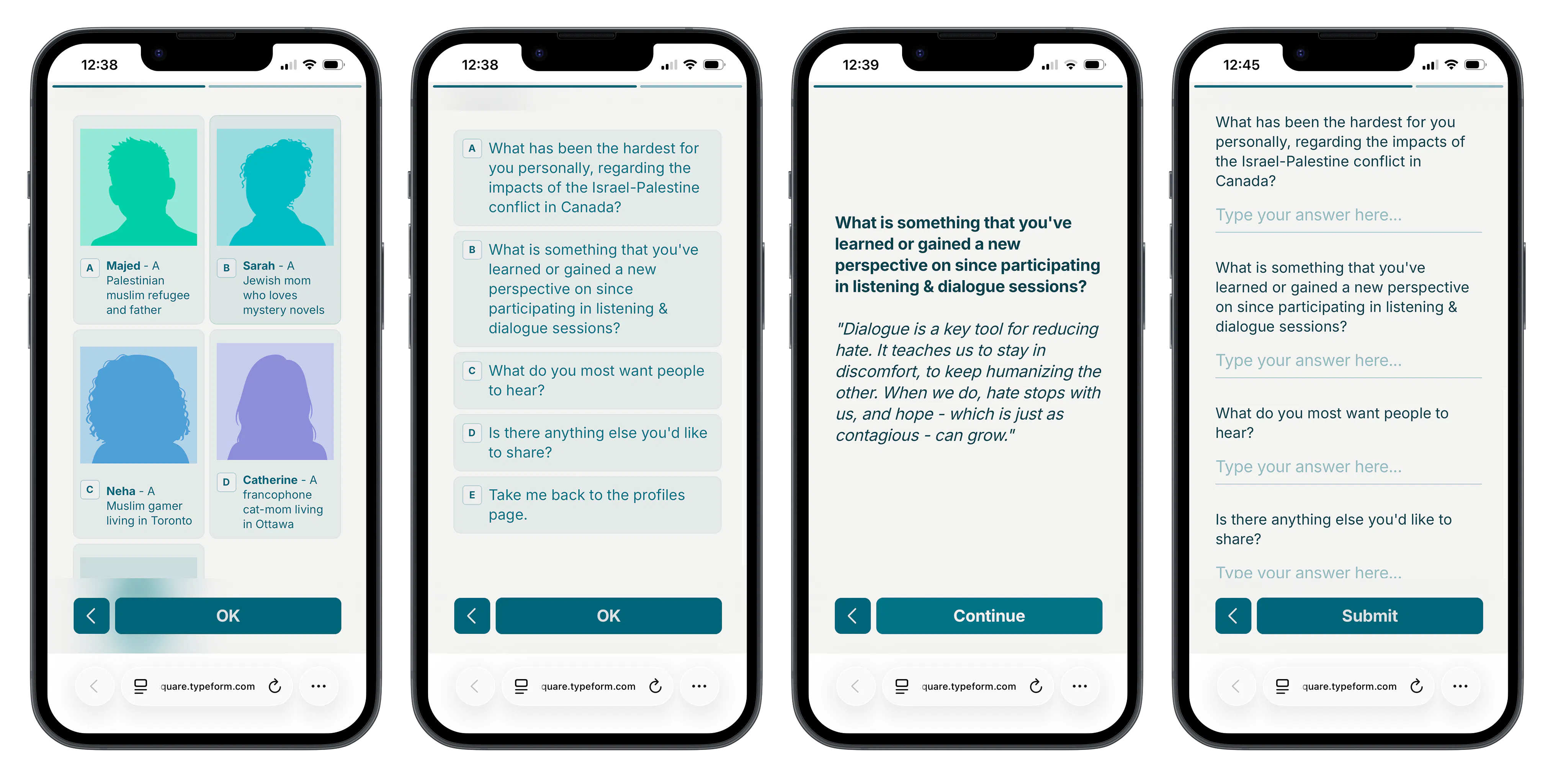
We designed Voices to incorporate the principles of contact theory – the idea that interactions between members of different groups reduces prejudice, stereotyping, and discrimination. Research has found that contact interventions can reduce conflict and intolerance between groups when they are structured under particular conditions.
When properly facilitated, contact interventions provide an opportunity for members of different groups to learn about the other, correct assumptions and misperceptions, and find common ground. Voices applies the principles of contact theory in a short digital experience where users can hear from diverse experiences and backgrounds, build empathy for those with different viewpoints, and explore polarizing issues in a safe, non-threatening, private environment.
Confronting polarization and intolerance at scale
Over 1,000 people engaged with the Voices pilot – and the initial results were promising. After using the platform, 47% said they gained an appreciation for a new perspective on Israel-Palestine different from their own, and 61% said they were interested in hearing more about perspectives and reflections on this issue from other Canadians. Further, 63 users volunteered to lend their voice to the discussion and share their own perspectives to create profiles for future versions of Voices.
These early results show the potential of Voices to build empathy for people whose views may be different than their own and encourage respectful conversations on contentious issues. Some participants also shared reflections about polarization surrounding Israel-Palestine after completing Voices:
“...people are hard to hate close up. We are all humans at the end of the day and some of the hate we see is not indicative of how most people feel.”
“The issue appears more polarized when looking at it from a broader scale, but it seems less polarized when taking into account individual perspectives.”
“People who are more involved in this crisis are not actually so different from me. Maybe there [isn’t] as much hopelessness for people as [I] thought. People [aren’t] filled with hate and for each other as [I] thought.”
“I live in rural Quebec and it’s not something we really talk about. I will try to understand it better I think.”
“...I would love to be a part of this kind of discussion if I knew that I [wouldn’t] be faced with negative consequences.”
These testimonials point to the importance of humanizing contentious issues to encourage empathy and reflection. Amid social media environments that reward conflict and division, Voices offers an alternative mode of engagement.
Digital Public Square is committed to scaling and refining Voices, building on what’s already working to reach more Canadians and deepen its impact. We see this model of structured digital dialogue as a powerful tool not just for bridging divides around Israel-Palestine, but for confronting polarization wherever it takes root in Canadian public life.
Interested in seeing it for yourself? Access Voices here.
Read more about our dialogue series here.
If you have any feedback on Voices, please send it to hello@digitalpublicsquare.org